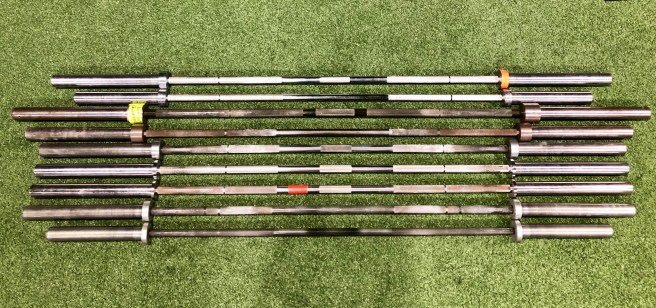
A bar is a bar is a bar, right? Wrong. Though all of the bars above may share many similarities, their differences mean that you’re better off using one or the other for given lifting tasks (and on the flip side, should really avoid using others for things they aren’t designed for!)
Let’s be real here. They all look mostly the same. They are all long, straight, have a place to load plates, and a place to hold the bar. They’re all kind of textured in the middle (this is knurling, and it helps to hold the bar on your back or in your hands). And because they all look so similar, it’s really easy for a gym veteran to accidentally grab an olympic weightlifting bar on deadlift day.
Fear not, veterans and newer lifters alike! Today I’m going to outline eight (EIGHT!) different types of straight bars you’re likely to see in the gym, what they’re used for, and how you can tell each of them apart. Ready? Here we go.
1. Competition Bar


There are currently eight bars approved by the IPF for use in competition (you can find a listing of all of the approved products here). The Cadillac among them is the Eleiko competition bar, which runs for just shy of $1,100, whereas an IPF approved Rogue Ohio Power bar can be purchased for only $325 (the other six approved bars range in between). Competition bars have a high tensile strength (which essentially means they can withstand a lot of stress before breaking) and are typically aggressively knurled. Essentially, a competition bar is meant to hold up to heavy weights, flex minimally while doing so, and grip well, whether in the hands (for deadlifts) or on the back (for squats).
Defining Characteristics:
- The sleeves. If the bar has thin (50mm) sleeves, it’s probably a competition bar
- End cap. If it hasn’t fallen off/out (it likely hasn’t if we are talking about a comp bar), the end cap will often specify that the bar is IPF approved.
- At peak gym hours, it’s probably in use. Gear fanboys will always know where this bar is
Dos/Don’ts:
- Do: Use it for the competition lifts
- Don’t: Jam it in a landmine, use it for rack pulls, drop it on things, or otherwise abuse it – especially if it’s an Eleiko. Breaking an $1,100 bar is not cool.
2. Training Bar


This will be a bar that is not necessarily approved for use in competition, but is perfectly suited for training and meant to withstand years of gym abuse. The Texas Power Bar ($350) is a perfect example of a great all-around bar, and one that you will probably find in almost every powerlifting gym. The grip marks on a training bar are the same as a competition bar.
Defining Characteristics:
- The sleeves. A training bar typically has thicker sleeves compared to a competition bar. This is honestly the number one way that I can quickly eyeball bars. Thin sleeves = probably a comp bar.
Dos/Don’ts:
- Do: Use it for your comp lifts. Use it for your accessories. You can pretty much use it for anything.
- Don’t: Honestly, most things are fair game.
3. General Use/Cross Training Bar


These bars tend to be less expensive than a training bar. Facilities that hold group training classes will likely have many of these, and they are a mainstay at CrossFit gyms. These bars will have grip markings for both powerlifting and olympic weightlifting (because they are expected to pull double duty for both). The knurling is also much less intense than what you will find on a competition or training bar:


Defining Characteristics:
- Dual markings. The two sets of hash marks in the knurling are the best way to tell a general use bar from a competition/training bar.
- Knurling. You will definitely notice that these bars are far less abrasive than a competition or training bar.
- Centre knurling. A lot of cross training bars will not have a centre knurling (to better allow athletes to do higher numbers of repetitions on exercises like cleans without rubbing the knurling on their chin/neck/collarbones repeatedly).
Dos/Don’ts:
- Do: This is the bar you want to pick for some of your “rougher” accessories like seal rows, rack pulls or to put in a landmine attachment. These bars are (a) less expensive and (b) designed to take a beating. That doesn’t mean do dumb things, but this is the bar that you can abuse a little bit more.
- Don’t: Be a bar snob. Using this bar is not going to kill you. If you’re two weeks out from your next meet or getting ready to smash your PR, sure, maybe wait in line for a better bar, but this bar is perfectly fine.
Note: Cross training bars also come in a 15kg/35# version (typically referred to as a women’s bar, as it is the same weight and dimensions as a women’s olympic weightlifting bar). In addition to being lighter than a powerlifting bar, it is also shorter and thinner.


4. Squat Bar
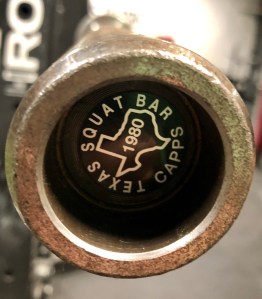
As the name suggests, a squat bar is used specifically for squatting. Not all powerlifting federations use this bar (the IPF and its affiliates do not). A squat bar is thicker than a normal power bar, and is substantially longer, with increased length in both the sleeves and the middle. Where a power bar has a smaller section of centre knurling with smooth sections to either side of it, a squat bar has a much longer centre knurl resulting in a bar that is fully knurled from collar to collar. A squat bar also weighs in heavier than a standard power bar at 25kg/55 pounds (so if you’re used to plate math on a 20kg bar, this bar can really throw you off!). These features all combine to make a bar with very little whip, meaning that the bar should not wiggle a lot, even when unracking heavy weights.


Defining Characteristics:
- Thicker and longer than a standard power bar
- Knurled from collar to collar (or very small space between centre knurling and main bar knurling)
Dos/Don’ts:
- Do: Squat with it.
- Don’t: Do anything else with it.
5. Deadlift Bar
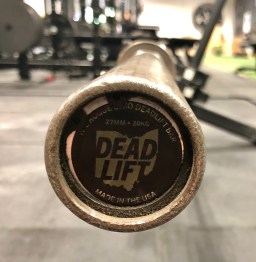 Like a squat bar being used for squats, a deadlift bar is used for deadlifting. Not all powerlifting federations use this bar (the IPF and its affiliates do not). What makes it different from a normal power bar is its diameter (thinner) and its length (longer). The sleeves are also slightly shorter on a deadlift bar, meaning that the extra length is in the middle of the bar. These factors all combine to increase the whip and flex of the bar, which means that the lifter should be higher off the ground when the plates finally break the floor. For many lifters, this means they can pull heavier weights than on a traditional stiff bar. In the video below, you can see just how this looks:
Defining Characteristics:
- Thinner and longer than a standard bar
- Wider sleeve ends than a standard bar
- No centre knurling
Dos/Don’ts:
- Do: Deadlift with it.
- Don’t: Do anything else with it.
6. Olympic Weightlifting Bar

I think it’s important to mention this one as a lot of specialty gyms cater to both the powerlifting and olympic weightlifting crowd, so there’s a chance you may find one of these kicking around. It may look really similar, but this is not a powerlifting bar (and shouldn’t be used for powerlifting!). Unlike a powerlifting bar that is built for stiffness, weightlifting bars are whippier (they bend and flex more). The markings on the bar are also different (the grip marks are 36″ apart on a weightlifting bar vs. 32″ on a powerlifting bar). Unless you have two bars lined up and are comparing the grip marks directly, this can be a little bit difficult to eyeball.
The key difference between a weightlifting bar and a powerlifting bar is that the sleeves on a weightlifting bar use bearings (instead of bushings) so that they spin really well – this is important/helpful considering the nature of the olympic lifts. If you’re ever in doubt as to whether a bar might by made for olympic weightlifting or powerlifting, spin the sleeve. The difference will be huge:
Defining Characteristics:
- No centre knurling, or a minimally textured/grippy centre knurling
- Grip marks that seem a little off from what you’re used to
- Sleeves that spin really fast
Dos/Don’ts:
- Do: Return this bar to the olympic weightlifting section of the gym
- Don’t: Load it up with steel plates and deadlift with it. Seriously. Don’t.
Note: In olympic weightlifting, men and women use different sizes of bars. A women’s weightlifting bar will have all the characteristics of a men’s olympic bar (great spin), but will be shorter, thinner, and lighter (15kg vs. 20kg). It also doesn’t have any centre knurling. Don’t powerlift with this one either.
So there we have it; the six most common straight bars you will find in your friendly neighbourhood powerlifting (or powerlifting/weightlifting) gym. Stick around, because next time I’m going to give a rundown of all the fun specialty bars laying around in the corners of the gym!
Confused by any other equipment in the gym? Let me know below!

 Two White Lights
2 thoughts on “Getting to Know Your Barbells, Pt. 1: The Straight Ones”